DeepExtractor: Minimal Example
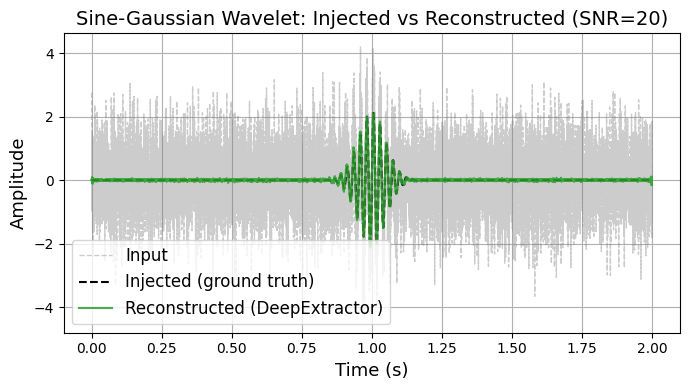
This notebook shows the core DeepExtractor workflow in the simplest possible way: one noise realization, one sine-Gaussian wavelet injected at SNR=20, reconstructed by the model, and plotted.
[1]:
import numpy as np
import torch
import matplotlib.pyplot as plt

import deepextractor
from deepextractor.generation.glitch_functions import generate_sine_gaussian
from deepextractor.generation.generate_timeseries import generate_gaussian_noise, SNR_SCALING_FACTOR_BILBY
from deepextractor.utils.signal import whitened_snr_scaling
---------------------------------------------------------------------------
ModuleNotFoundError                       Traceback (most recent call last)
Cell In[1], line 5
      1 import numpy as np
      2 import torch
      3 import matplotlib.pyplot as plt
      4
----> 5 import deepextractor
      6 from deepextractor.generation.glitch_functions import generate_sine_gaussian
      7 from deepextractor.generation.generate_timeseries import generate_gaussian_noise, SNR_SCALING_FACTOR_BILBY
      8 from deepextractor.utils.signal import whitened_snr_scaling

ModuleNotFoundError: No module named 'deepextractor'
[2]:
SAMPLE_RATE = 4096
T = 2.0                        # total duration (seconds)
LENGTH = int(T * SAMPLE_RATE)  # 8192 samples
T_INJ = T / 2                  # inject signal at midpoint
SNR = 20
DEVICE = "cuda" if torch.cuda.is_available() else "cpu"
Step 1 — Generate noise and inject a sine-Gaussian wavelet
[3]:
# One realization of bilby-simulated noise (whitened L1 strain)
noise = generate_gaussian_noise(0, np.sqrt(SAMPLE_RATE), 1, (LENGTH,), bilby_noise=True)[0]
Generating bilby noise...: 100%|██████████| 1/1 [00:00<00:00, 242.47it/s]
[4]:
# Generate a sine-Gaussian wavelet (0.5 s duration, max frequency 64 Hz)
_, wavelet = generate_sine_gaussian(duration=0.5, freq_max=64)
wavelet = wavelet - np.mean(wavelet)        # remove DC offset
wavelet = whitened_snr_scaling(wavelet, snr=SNR / SNR_SCALING_FACTOR_BILBY)  # scale to SNR=20 in bilby frame

# Inject into noise at the midpoint
len_glitch = len(wavelet)
id_start = int(T_INJ * SAMPLE_RATE) - len_glitch // 2

noisy_glitch = noise.copy()
noisy_glitch[id_start : id_start + len_glitch] += wavelet

# Ground-truth: the injected signal zero-padded to full length
injected = noisy_glitch - noise
Step 2 — Load the DeepExtractor model
[5]:
# Downloads weights automatically from Hugging Face Hub if not cached locally.
# The scaler is loaded from assets/scaler_bilby.pkl automatically.
model = deepextractor.DeepExtractorModel(device=DEVICE)
print(f"Model loaded on: {model.device}")
/opt/homebrew/Caskroom/miniforge/base/envs/deepextractor/lib/python3.12/site-packages/sklearn/base.py:463: InconsistentVersionWarning: Trying to unpickle estimator StandardScaler from version 1.5.2 when using version 1.8.0. This might lead to breaking code or invalid results. Use at your own risk. For more info please refer to:
https://scikit-learn.org/stable/model_persistence.html#security-maintainability-limitations
  warnings.warn(
/opt/homebrew/Caskroom/miniforge/base/envs/deepextractor/lib/python3.12/site-packages/tqdm/auto.py:21: TqdmWarning: IProgress not found. Please update jupyter and ipywidgets. See https://ipywidgets.readthedocs.io/en/stable/user_install.html
  from .autonotebook import tqdm as notebook_tqdm
Model loaded on: cpu
Step 3 — Reconstruct with DeepExtractor
model.reconstruct() handles the full pipeline internally:
Scale the input with the pretrained StandardScaler
Compute the STFT (spectrogram) of the noisy input
Feed it through the U-Net — the model outputs a clean background (noise-only) estimate
Inverse STFT → undo scaling → subtract background to recover the signal
[6]:
reconstructed = model.reconstruct(noisy_glitch)
[7]:
t = np.linspace(0, T, LENGTH)

fig, ax = plt.subplots(figsize=(7, 4))
ax.plot(t, noisy_glitch,      label='Input', color='gray', linestyle='--', linewidth=1, alpha = 0.4)
ax.plot(t, injected,      label='Injected (ground truth)', color='black', linestyle='--', linewidth=1.5)
ax.plot(t, reconstructed, label='Reconstructed (DeepExtractor)', color='C2', linewidth=1.5, alpha=0.85)
ax.set_xlabel('Time (s)', fontsize=13)
ax.set_ylabel('Amplitude', fontsize=13)
ax.set_title('Sine-Gaussian Wavelet: Injected vs Reconstructed (SNR=20)', fontsize=14)
ax.legend(fontsize=12)
ax.grid(True)
plt.tight_layout()
plt.show()
[ ]: